1708 S Alexander St Plant City, FL 33563


Spring Dental Care Guide for Plant City Families — What Your Dentist Wants You to Know This Season

Spring in Plant City moves fast. Between spring break travel, kids’ sports leagues kicking into gear, and end-of-school schedules stacking up, most families find themselves busier than expected — and dental appointments are usually the first thing that quietly disappears from the calendar.
The problem is that your teeth do not take a break just because your schedule is full. And the issues that get ignored in March have a way of becoming the emergencies that show up in June, right before summer travel or a school event you did not want to deal with this way.
This guide covers five things that genuinely matter for your family’s oral health this spring — written not as a checklist, but as practical context that helps you make better decisions over the next few months.
Why Spring Specifically Creates Dental Risk
Most people do not associate the season with their oral health, but there are several spring-specific factors that consistently show up in patient visits this time of year.
Seasonal allergies — which peak across central Florida from late February through April — cause significant nasal congestion in a large portion of the population. When nasal passages are blocked, people breathe through their mouths, often without realizing it. Chronic mouth breathing reduces saliva flow, and saliva is your mouth’s primary natural defense against bacteria. Less saliva means a drier oral environment, which accelerates plaque accumulation and raises the risk of both cavities and gum inflammation. Patients who have never had significant dental issues sometimes see their first cavity in their 30s or 40s during a particularly bad allergy season — and the connection is rarely obvious without a professional evaluation.
Sports and outdoor activity levels also spike in spring. Plant City’s youth baseball, soccer, travel softball, and recreational leagues all run heavily from March through May. Higher activity means a higher probability of dental trauma — cracked teeth, knocked-out teeth, and soft tissue injuries from contact or collision. Many of these injuries are preventable with the right protection.
Finally, spring break and after-school social habits tend to increase consumption of acidic and sugary beverages — sports drinks, lemonades, sodas, and fruit juices. These drinks do not cause immediate pain, so the damage they create is easy to dismiss. But repeated acid exposure gradually erodes enamel in a way that cannot be reversed, only managed.
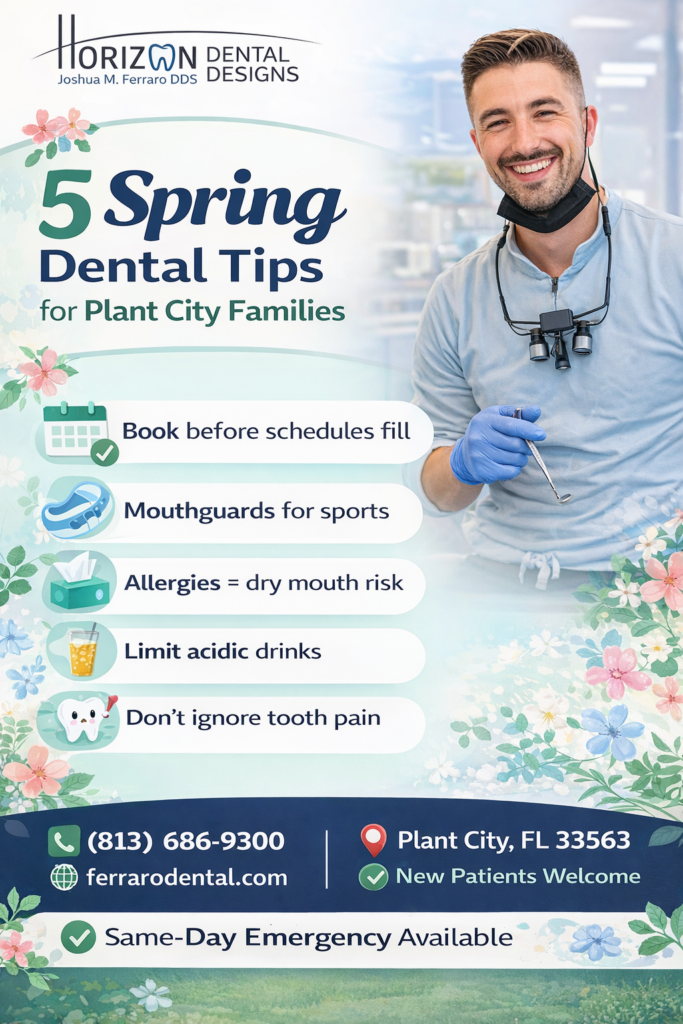
1. Schedule Your Cleaning Before the Calendar Locks Up
This is the most straightforward recommendation on this list, and also the one most likely to get skipped precisely because it feels optional when nothing hurts.
Professional cleanings do two things that your home routine cannot replicate. First, they remove calculus — the hardened mineral deposits that form when plaque is not fully cleared — from areas that are difficult to reach with a toothbrush or floss. Once calculus forms, it can only be removed with professional instruments. Left in place, it harbors bacteria and drives gum inflammation.
Second, a cleaning visit includes a comprehensive examination. This is where small problems get caught. A tiny crack that has not caused pain yet. An area of early decay that can be addressed with a simple filling today but would require a crown in six months. Early-stage gum recession that needs monitoring. None of these generate symptoms in their early stages, which is exactly why the examination matters.
Spring is the right window because schedules have not fully locked up yet. By late April and May, between sports tournaments, school events, and vacation planning, finding a convenient appointment slot becomes genuinely difficult. Booking in March or early April means you maintain continuity of care without scrambling.
2. Spring Sports Season and Dental Trauma — What Parents Should Know
Youth sports participation in the Plant City area is high, and spring is peak season for most outdoor leagues. What many parents do not realize is that dental injuries are among the most common sports injuries in children and adolescents — and that a significant majority of them are preventable.
A knocked-out permanent tooth is a genuine dental emergency. If it happens during a game and is not handled correctly within the first 30 to 60 minutes, the tooth may not be successfully reimplanted. Knowing what to do in that situation — keep the tooth moist, handle it by the crown not the root, get to a dental office immediately — can be the difference between saving and losing a permanent tooth.
Custom-fitted mouthguards, made from an impression of your child’s actual teeth, provide substantially better protection than the boil-and-bite versions sold at sporting goods stores. They fit more securely, interfere less with breathing and speaking, and are more likely to actually be worn because they are more comfortable. If your child plays any contact or collision sport this spring, a conversation about a custom mouthguard is worth having before the season is fully underway.
Adults are not exempt from this either. Recreational softball leagues, cycling, running, and casual contact activities all carry some level of dental injury risk. A chipped front tooth or a cracked molar from an unexpected fall is not a rare occurrence — it just tends to catch people off guard.
3. Allergies, Dry Mouth, and Your Cavity Risk This Spring
This connection is underappreciated by most patients, and it is worth understanding clearly.
Saliva does several important things for your oral health simultaneously. It physically washes bacteria and food particles off tooth surfaces. It contains proteins that inhibit certain bacterial strains. It neutralizes the acids produced by bacteria after you eat or drink. And it provides minerals that support enamel remineralization — the natural process by which small areas of early enamel damage can be partially repaired.
When saliva flow is reduced — whether from allergy medications, mouth breathing, dehydration, or a combination of all three — all of these protective functions are diminished at the same time. Patients who take antihistamines regularly during allergy season often experience noticeably drier mouths as a side effect, which compounds the issue.
Practical steps that help: staying well hydrated throughout the day, chewing sugar-free gum to stimulate saliva flow, breathing through the nose whenever possible even when congested, and avoiding alcohol-based mouthwashes during allergy season since alcohol further dries oral tissue.
If you have significant seasonal allergies and you have noticed increased tooth sensitivity or more frequent cavities in recent years, mentioning this at your next visit with a family dentist in Plant City is worth doing. There are prescription-strength fluoride options and remineralizing agents that can provide additional protection during high-risk periods.
4. Acidic Drinks and Enamel Erosion — The Damage You Cannot See Yet
Enamel erosion is one of the most common conditions dental professionals see, and it is almost entirely driven by dietary habits rather than poor hygiene. The patients who develop it are often meticulous brushers and flossers — they simply do not realize that what they are drinking is doing more damage than any plaque.
The mechanism is straightforward. Acidic drinks — which include sports drinks, citrus juices, sodas, kombucha, energy drinks, and even some sparkling waters — temporarily soften the surface layer of enamel with each exposure. Saliva gradually neutralizes this acid and allows partial remineralization, but if exposures are frequent throughout the day, the remineralization process cannot keep pace.
The consequences of significant enamel erosion include increased sensitivity, yellowing of teeth as the underlying dentin becomes more visible, rounded or translucent tooth edges, and higher susceptibility to cavities. None of these are reversible — eroded enamel does not grow back. The damage can be managed and protected against with restorative treatments, but prevention is fundamentally more effective.
Spring break and post-school hours increase beverage consumption, particularly among children and teenagers. Simple habit adjustments — drinking acidic beverages through a straw, rinsing with water immediately after, and avoiding brushing for at least 30 minutes after acid exposure while enamel is temporarily softened — meaningfully reduce the rate of erosion.
5. Tooth Pain in Spring — Why This Is the Right Time to Address It
There is a consistent pattern in dental practices: a large number of patients who arrive with dental emergencies in summer — cracked teeth, abscesses, significant decay — had symptoms that were noticeable weeks or months earlier and were not acted on.
Tooth pain or persistent sensitivity is not something that resolves on its own in the vast majority of cases. The underlying cause — a crack, deep decay, an infection, a failing restoration — continues to progress whether or not it is currently symptomatic. The window where a problem can be addressed with a relatively straightforward and affordable treatment is not indefinite.
Spring is genuinely a better time to deal with a dental concern than summer for practical reasons. Appointment availability is better. You are not disrupting a planned vacation or summer activity. If a treatment requires multiple visits — a crown, a root canal, an implant restoration — there is more scheduling flexibility before summer fills up.
If you or a family member has been noticing sensitivity to temperature, discomfort when biting, intermittent aching, or any change in how a tooth feels, that information is worth sharing with a dental professional sooner rather than later. A same-day evaluation can usually determine within a single visit whether something needs immediate attention or can be monitored and scheduled on a timeline that works for you.
Serving Plant City and the Surrounding Community
Horizon Dental Designs is located at 1708 S Alexander St, Plant City, FL 33563, and serves patients from across the Plant City area, including Downtown Plant City, Walden Lake, Hopewell Gardens, and neighboring communities throughout Hillsborough County.
Dr. Joshua M. Ferraro and the Horizon Dental Designs team provide general, preventive, cosmetic, and emergency dental care for patients of all ages. New patients are always welcome, and same-day emergency appointments are accommodated whenever possible.
📞 (813) 686-9300 🌐 www.ferrarodental.com 🕐 Monday – Thursday: 7:00 AM – 2:30 PM